Alternative feeds and sustainability are linked because farmed fish eat more than ever, and the ingredients in their feed shape the environmental footprint of the fillet you buy. Replacing some fishmeal and fish oil with other ingredients can take pressure off wild forage fish, but every substitute has trade-offs.
The main alternatives
Plant proteins and oils
Soy, wheat, corn, peas and canola are widely used in aquafeed. They are cheap and available at scale, which is why they replaced a large share of marine ingredients. Concerns include land use, and in some regions the link between soy expansion and deforestation. Responsible sourcing programs for crops exist, though coverage varies.
Insect meal
Insect larvae such as black soldier fly can be raised on organic waste streams and processed into protein meal. They are promising and are in commercial use for some fish diets, but the supply is still small compared with the volumes used by the industry, and costs have limited uptake.
Algae and microbial ingredients
Algae oil provides the omega-3 fats EPA and DHA that fish normally obtain from eating smaller fish and algae. Single-cell proteins from bacteria or yeast grown on feedstocks are also being developed. These can help keep omega-3 levels in farmed fish without wild-caught oil, though they cost more.
Processing by-products
Trimmings from fish processing can be turned into fishmeal and oil, which makes use of material that would otherwise be waste. See byproduct utilization in seafood processing.
What alternative feeds and sustainability mean for shoppers
Feed is invisible on a label, so shoppers should rely on indirect signals. The ASC farm standard includes feed requirements, and the Seafood Watch assessments consider feed as part of a farm's overall rating. Check the current standard or rating for details rather than assuming.
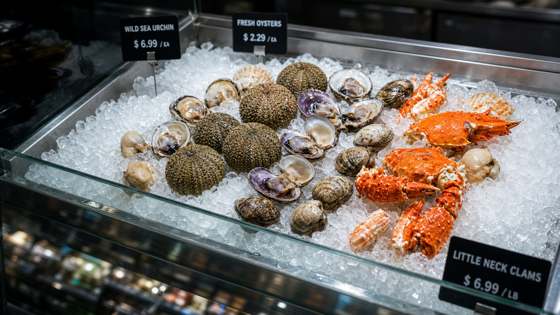
- Choose species that need little or no feed, such as farmed oysters, mussels and clams.
- Look for certified farmed salmon, trout or shrimp when you buy those fish.
- If omega-3 content matters to you, check producer information, since plant-heavy feeds can lower it unless supplemented.
Are alternative feeds and sustainability claims always reliable?
Not automatically. "Fed with insects" or "wild-fish-free" can be accurate but may hide other impacts such as energy use or crop sourcing. Ask what share of the feed the alternative ingredient makes up and whether the producer publishes data. Our guide to wild fish feed dependency explains the issue these feeds are trying to solve, and alternative proteins in aquafeed goes into the science more closely.
It is worth knowing why feed gets so much attention. For fed species, feed is typically the largest cost on a farm and a major part of its environmental footprint, because growing crops, catching fish or producing insects all use land, energy and water. Improving feed efficiency, meaning how much feed it takes to grow a kilogram of fish, helps both the farmer's finances and the environment. Better breeding, health management and feeding practices all contribute, and this is why many companies work on several levers at once.
Fish farmed for restoration or low-impact uses, such as seaweed and shellfish, avoid the issue altogether. If you are curious about the technology, feed formulation for farmed fish explains how diets are designed. For you as a shopper, the takeaway is that the feed debate is about direction of travel: less wild fish, fewer crops with a high environmental cost, more use of waste streams and new ingredients, and honest reporting about what works.
In closing, keep alternative feeds and sustainability in perspective: a farmed fish from a well-run, certified operation with a mixed, responsibly sourced diet is generally a better choice than an uncertified product with no information at all.
Where it is heading
Over time, feed will likely include a mix of crops, by-products, algae and insects. The FAO tracks developments in aquaculture feed use worldwide. On alternative feeds and sustainability, your best move as an everyday shopper is to favor low-feed seafood, choose certified products, and stay skeptical of simple claims.