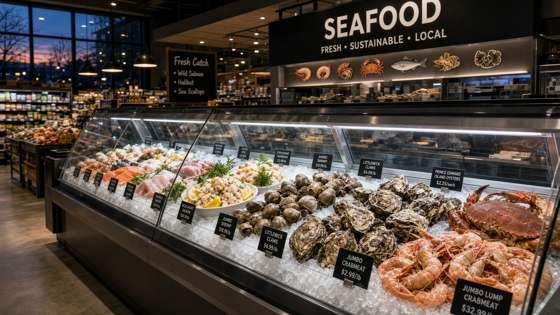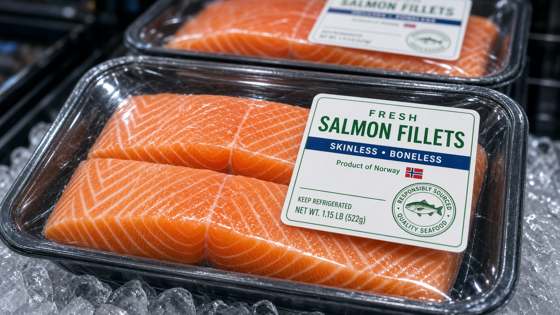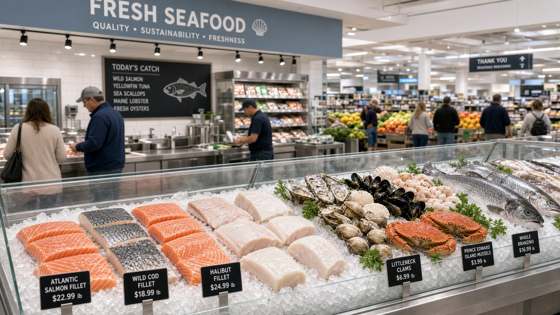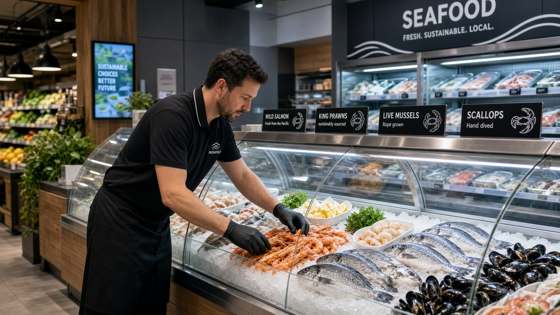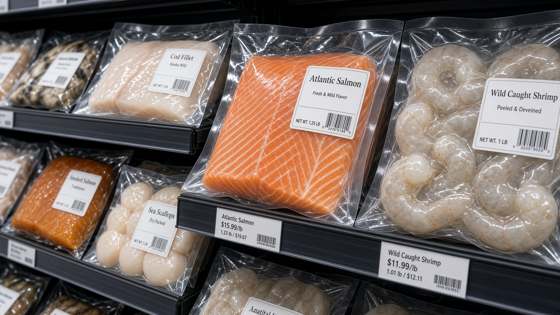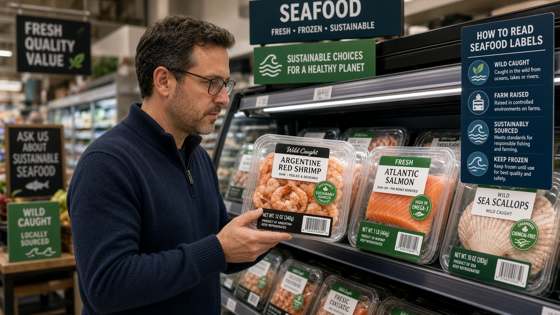
When a supermarket sign promises sustainable seafood, the word is doing a lot of work, and it does not mean the same thing in every store or on every product. Sometimes it points to an independent certification you can check. Sometimes it describes the retailer's own sourcing policy. Occasionally it is little more than a general claim that nobody has defined for you.
Three things sustainable seafood can mean on a sign
It helps to sort the claims you see into three buckets, because each one carries a different level of proof.
- A third-party certification. An outside body has audited a fishery or farm against a published standard, and the product carries a logo.
- A species-level rating. A conservation group scores a species from a given place and method, and a store may say it only sells "green" or "yellow" choices.
- A retailer policy. The company states its own goals, such as sourcing everything from responsible sources by a set date. That is a commitment, not a guarantee about the fillet in your hand.
What the MSC blue fish label checks
The Marine Stewardship Council label is for wild-caught fish. According to the MSC's own explanation of the label, an independent assessor looks at three things: whether fish populations are protected, whether other ocean life is cared for, and whether the fishery is well managed. A fishery has to score at least 60 on every indicator and average at least 80 overall, and certified fisheries are audited every year and reassessed every five years.
Two limits matter for shoppers. First, the MSC says its label covers environmental performance only, not social or economic conditions such as crew treatment. Second, a certificate applies to a specific fishery, meaning a species, area and fishing method, not to a whole company. A business can run both certified and uncertified fisheries.
Sustainable seafood from farms and the ASC
Farmed seafood is handled by a different program. The Aquaculture Stewardship Council (ASC) certifies responsible fish and shellfish farming, and some products carry the MSC and ASC logos side by side. Retailers also use other farming standards, such as Best Aquaculture Practices or GLOBALG.A.P., which you will see named on some store pages. They are not identical, so a farmed fillet with a different logo is not necessarily lower quality, just assessed against another rulebook.
Seafood Watch and other ratings
The MSC notes in its comparison of seafood labels that groups such as Seafood Watch publish species-level recommendations using their own criteria, and many factor in MSC certification. You can search any species yourself on the Seafood Watch recommendation search, which is useful when a counter has no logo to read.
How to test a sustainability claim at the counter
You do not need to be an expert. A few plain questions sort strong claims from vague ones.
- Ask whether the product is certified, and by whom. A real answer names a logo or a program.
- Ask where it was caught or farmed and how. Country of origin and wild or farmed status are required on many unprocessed fish and shellfish at US stores; the COOL guide explains what to expect.
- Check that the word on the sign matches the label on the pack. A "responsibly sourced" display above a product with no logo or origin is worth a second question.
- Look the species up on Seafood Watch before you leave, especially for tuna, salmon and shrimp where methods and farms vary widely.
Why the details matter
Sustainability claims have started to draw legal scrutiny. In 2026 a proposed class action over the "sustainable" marketing of farmed salmon was filed against the Hannaford supermarket chain, and a separate suit made allegations about seafood claims on Amazon. Both are only allegations that courts have not decided, and we cover the Hannaford case in our explainer. The practical lesson is simply that a general word on a sign deserves a follow-up question.
Chain stores do publish real commitments, and several are covered elsewhere in this section, including how to decode the labels on chain-store packs. Treat each as a starting point, check the logo and origin on what you are buying, and you will know quickly whether the sustainable seafood on offer is backed by an audit, a rating or just a slogan.