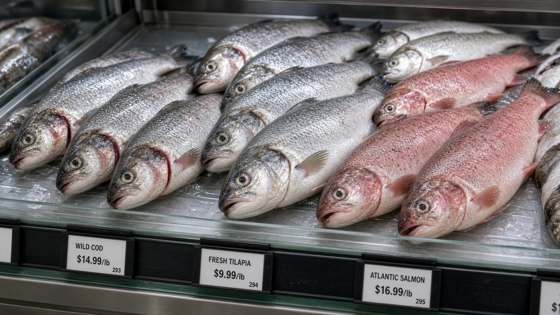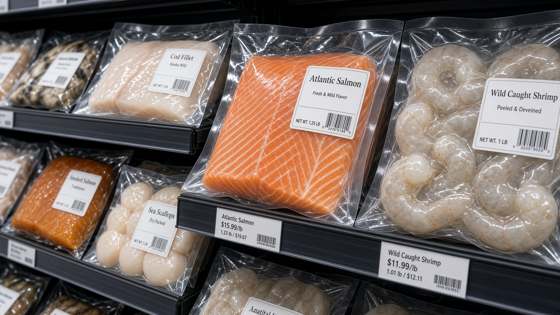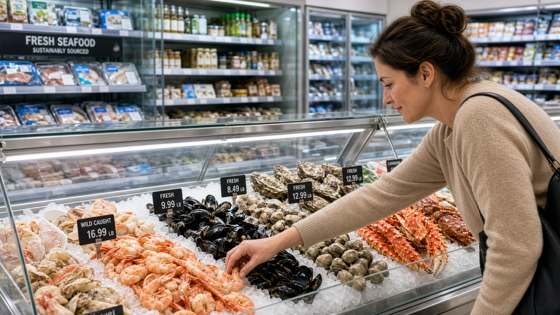
Own-brand seafood is made to the retailer's specification, which can be an advantage and a risk: the chain has direct control over its suppliers, but you are relying on that chain's published policy and your own reading of the label. Quality and sourcing vary between chains, so the answer to whether it is worth trusting is "check, then decide".
What chains say about their own labels
- Aldi UK states a target that 100% of fish and seafood in its own-label products is responsibly sourced, using MSC for wild fish and programs such as ASC and Best Aquaculture Practices for farmed fish, per its corporate page. It gives no percentages for how much of the range currently meets it.
- Lidl GB states a goal that 100% of own-brand fresh, frozen and tinned fish and seafood comes from responsibly managed fisheries and farms, and says 100% of its core shrimp range is certified to ASC, GLOBALG.A.P. or BAP.
- Sainsbury's reports 100% of farmed seafood sales meeting ASC or another credible standard, and 86.8% of wild-caught sales MSC certified in 2024/25. Its figures cover total seafood sales, not own brand alone.
- Walmart aims for all shelf-stable private and national brand tuna to come from an improvement project or MSC source, according to its 2023 announcement.
These are the retailers' own claims, so the logo on the pack is the practical check.
Where own-brand seafood falls outside the policy
Policies do not always cover everything. SeaChoice's 2025 profile of Costco Canada says its seafood policy covers Kirkland Signature products and some indirect products but not third-party brands. Greenpeace says Trader Joe's mainly sells own-label products and discloses little about suppliers. Neither statement means the products are poor; they mean the available evidence is limited, so read each pack.
How to test an own-brand seafood pack
- Look for a recognised logo, such as MSC or ASC, rather than a general phrase.
- Read the origin and the wild or farmed line; see our guide to reading seafood labels.
- Check the ingredients list on frozen and breaded products for added water or phosphates if that matters to you.
- For tuna, look for the catch method.
- Compare against a branded equivalent on unit price and label, not the packaging.
- Follow the FDA's storage advice: undamaged frozen packs without heavy frost, fresh fish at 40 F or below and used within two days (FDA seafood guidance).
Is own-brand seafood good value?
Own-brand seafood is frequently cheaper than a national brand, and many shoppers find it perfectly good. The value question is not just the price, though; it is whether the label gives you enough verifiable detail. If it names a standard, a method and an origin, trust it as far as you would any labelled product. If it says only "responsibly sourced", ask for specifics.
Our guide to supermarket seafood labels and the piece on the transparency gap help you judge how much information a chain provides.
So, is own-brand seafood worth trusting? Often yes, provided you treat the logo, origin and method as the evidence and the chain's policy as the context. Buy what the pack can prove, and ask the store about the rest.