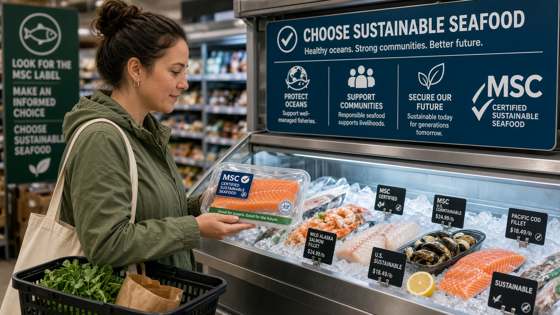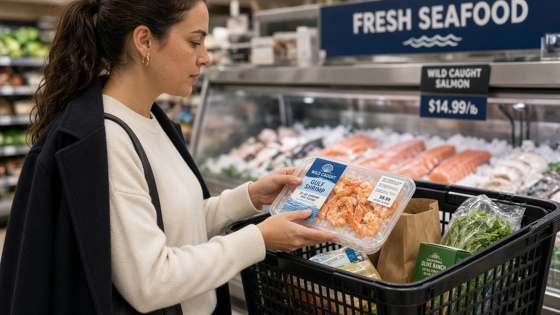
Shrimp welfare has moved from a campaigner's issue to a standard line in supermarket policy: by April 2026, according to Global Seafood Alliance reporting, all 11 major UK supermarkets had set time-bound welfare targets for farmed shrimp. That is a notable shift, but the deadlines vary and many are still in the future, so it helps to know what each pledge actually promises.
Shrimp welfare: the two practices behind the pledges
- Eyestalk ablation is the removal or crushing of an eyestalk on breeding female shrimp to speed up egg production. Many pledges promise to end it in the supply chain.
- Electrical stunning renders the animal insensible before slaughter, as an alternative to methods such as chilling in ice slurry. Pledges promise to move to stunning or similar methods.
These are farm and slaughter practices that shoppers cannot see on the pack, which is why retailer commitments matter.
What each retailer has said
The Global Seafood Alliance report from 9 April 2026 names several retailers. It says Aldi Sud will use electrical stunning, or similar methods, for all farmed shrimp by 2035 and end eyestalk ablation across its supply chain by 2030, with a policy that covers Europe, the US and Australia. It says Ocado has completed its transition to electrical stunning, and that Waitrose, Marks and Spencer and Tesco have set similar goals, some aiming for 2026. The article names only six retailers, so check each chain's own page for specifics.
Retailer pages worth reading
Company pages give more detail. Lidl GB states on its seafood page that eyestalk ablation has not been used for its core own-brand farmed warm-water shrimp since January 2026, and that electrical stunning is to be introduced by the end of 2026. Sainsbury's states on its responsible seafood sourcing page that its chilled and frozen prawn supply chains are free of eyestalk ablation, with stunning being trialled and full rollout estimated for the end of 2026. Waitrose says it trialled electrical stunning from 2023 with the Shrimp Welfare Project and plans a rollout by the end of 2026. These are company statements about their own progress.
What a shopper can actually do
Pledges do not appear on most prawn packs yet, so use these steps:
- Read the chain's published seafood policy for dates and wording, and note whether a target says "own brand" or "core range" only.
- Look for farming standards on the pack, such as ASC, BAP or GLOBALG.A.P.; our guide to BAP certification explains one of them.
- Ask whether the product is from the transitioned supply chain, since rollouts happen in stages.
- Choose according to your own priorities, which might include welfare, price and environmental ratings from Seafood Watch.
US shoppers and shrimp welfare
The Global Seafood Alliance article says Aldi Sud's policy covers the US as well as Europe and Australia. We did not find a verified, US-wide equivalent for American supermarkets in our research, so check each chain's own site. Farmed shrimp quality and handling guidance is covered in our overview of the global shrimp farming industry.
A timeline is a promise, not a delivered result. The practical way to treat shrimp welfare pledges is to note the deadline, look for the retailer's annual update and, when it matters to you, ask the store which of its prawns are already covered.