Supermarket influence on fishing is real because large retailers buy in enormous volumes and can set rules their suppliers must follow. Several chains have published specific commitments that show how this works in practice, and the examples below come from company statements and independent reports.
Supermarket influence on fishing through supplier rules
Walmart's 2023 tuna policy is a clear example. According to Walmart's announcement, suppliers to Walmart U.S., Walmart Canada and Sam's Club are to source only from vessels with 100% observer monitoring by 2027, and shelf-stable tuna is to come from a Fishery Improvement Project or MSC certified source by a 2025 goal. Greenpeace's tuna report argues the policy's transshipment caveat is a weakness, which shows that even a published rule can be debated.
Supermarket influence on fishing: improvement projects
Not every fishery is certified, and chains sometimes back projects that aim to get there. Sainsbury's states that fisheries not yet MSC certified are addressed through Fishery Improvement Projects, and says it is a member of the Global Tuna Alliance and the Global Ghost Gear Initiative. Lidl GB states that in 2018 it committed to fund a UK fisheries improvement project supporting more sustainable Nephrops sourcing in the North Sea, Irish Sea and west of Scotland. Both are company statements on their own pages.
Changing how animals are farmed
Retailer pressure also reaches farms. The Global Seafood Alliance reported in April 2026 that all 11 major UK supermarkets had set time-bound shrimp welfare targets, including Aldi Sud's pledge to end eyestalk ablation by 2030 and use electrical stunning for farmed shrimp by 2035 across Europe, the US and Australia. Our article on shrimp welfare pledges covers the detail. In the US, Aldi agreed after lawsuits over its salmon labelling to revise marketing and begin shifting some supply to ASC or Global Animal Partnership certified farms, according to SeafoodSource, while denying the labelling was misleading.
Labour and human rights
Whole Foods introduced a Seafood Code of Conduct that Greenpeace says bans worker-paid recruitment fees and requires grievance mechanisms and some crew communication access. Greenpeace credits it for the chain's top ranking while noting it still allows up to 11 months at sea. Read the Greenpeace report page for the full context.
What this means for shoppers
Retailer rules can matter, but their effect depends on follow-through, which is why independent checks matter. Some practical steps:
- Read the chain's policy for dates and specifics rather than slogans.
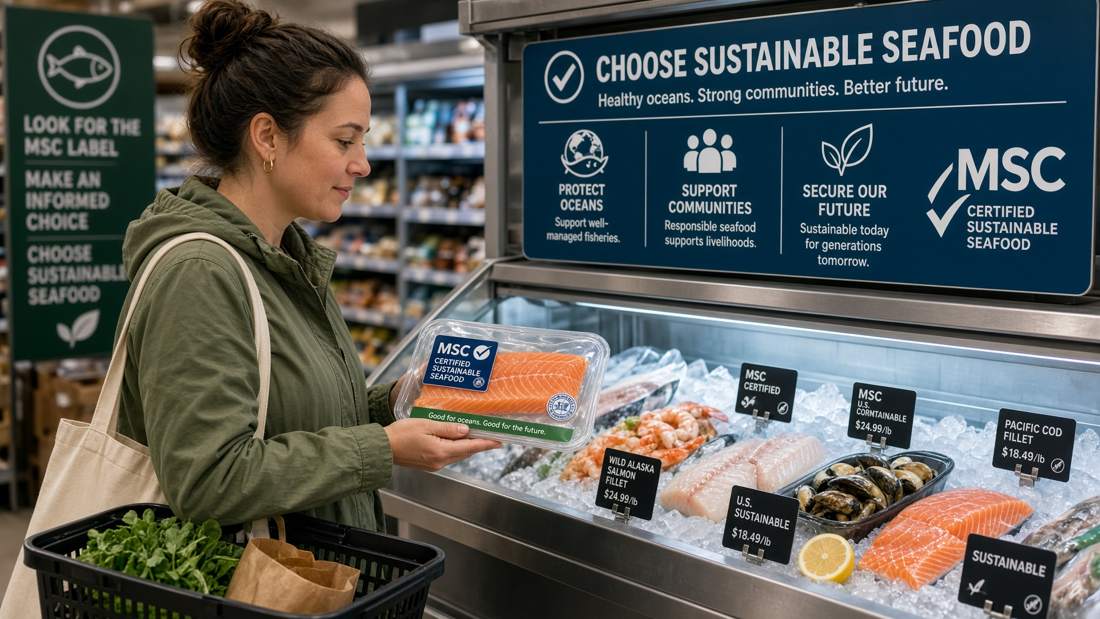
- Look for third-party logos on the pack; our guide to MSC and ASC certification explains two of them.
- Check species ratings on Seafood Watch.
- Pay attention to updates; targets such as 2027 observer monitoring are checkable when the date arrives.
For the supply side, see what supermarket supply chains mean for your fish's journey.
Supermarket influence on fishing works through procurement rules, funded projects and public targets. As a shopper, you add to that influence every time you choose a labelled product or ask a store how its policy is working.