The Greenpeace tuna scorecard is the most widely quoted ranking of US supermarkets on seafood, and its latest edition shows both real differences between chains and a lot of low scores. It is also narrower than its headlines suggest: it scores tuna supply chains, not every product in the store.
The 2025 scorecard results
The fourth edition of the High Cost of Cheap Tuna report, published on 16 March 2026 and summarised on the Greenpeace USA report page, assessed 16 major US retailers and found that only two received passing scores. In the full report, the overall percentages were:
- Whole Foods 71% (first, up from 58%) and Aldi 69% (second), the two passing scores.
- Target and Hy-Vee 59% each, then Ahold Delhaize USA 52%, Sprouts 45% and Walmart 40%.
- Albertsons 34% and Kroger 32% in the middle of the lower group.
- At the bottom, H-E-B 25%, Wegmans 22%, Costco 21%, Publix 20%, Meijer 17% and Trader Joe's 12%.
Greenpeace says Aldi slipped to second mainly because of fewer advocacy efforts during the reporting period, and that Hy-Vee, which passed the previous year, ended just below passing. Giant Eagle's figure appears inconsistently in the report, so we have not listed it.
How the Greenpeace tuna scorecard survey works
The survey has 39 scored questions grouped into categories that include tuna procurement policy, traceability (weighted at 20%), advocacy, human rights and labour protections, current sourcing and customer labelling. Nine of the 16 retailers responded. Seven did not and were scored on public information: Costco, H-E-B, Publix, Walmart, Trader Joe's, Meijer and Wegmans. That means a low score can partly reflect a company's decision not to engage.
What came before
Greenpeace's earlier Carting Away the Oceans series ranked supermarkets more broadly on seafood sustainability. Its 10th-anniversary edition, published on 15 August 2018, listed Whole Foods, Hy-Vee, ALDI and Target at the top, Price Chopper, Save Mart and Wakefern at the bottom, and said 90% of the 22 assessed retailers passed. The two reports use different methods, so scores cannot be compared directly.
How to read a Greenpeace tuna scorecard fairly
- It is one organisation's view. Greenpeace is an advocacy group with its own priorities, and says no retailer is fully addressing the issues.
- It looks at tuna. Salmon, shrimp and white fish are not scored.
- It weights policy and disclosure. It does not test the fish in a given tin.
- It is a snapshot. Scores move; Whole Foods rose 13 points in one edition.
Using the results when you shop
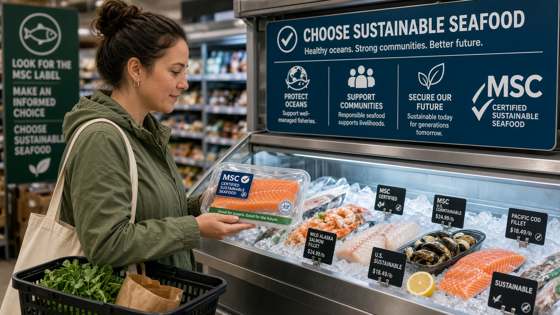
Treat the scores as a prompt to look more closely. Read the catch method on tins, look for MSC or similar logos, and check the species on Seafood Watch. For individual chain details, see our pieces on Whole Foods and Trader Joe's, and for more on disclosure, the transparency gap.
The useful takeaway from the Greenpeace tuna scorecard is that chain policies differ widely and are improving only slowly. Use the ranking to ask your store better questions, and rely on the label in your hand for the purchase itself.